Head Office
Chennai, India
Email For Us
rrmineralspro@gmail.com
Call For Us
+91 6382001809

A Complete Guide to Vermiculite and Its Applications


Introduction

Vermiculite is a naturally occurring mineral that has become an essential material across several industries due to its unique physical and chemical properties. Discovered in the early 20th century, vermiculite gained commercial importance when it was found that heating the mineral causes it to expand dramatically, forming lightweight and highly absorbent particles.

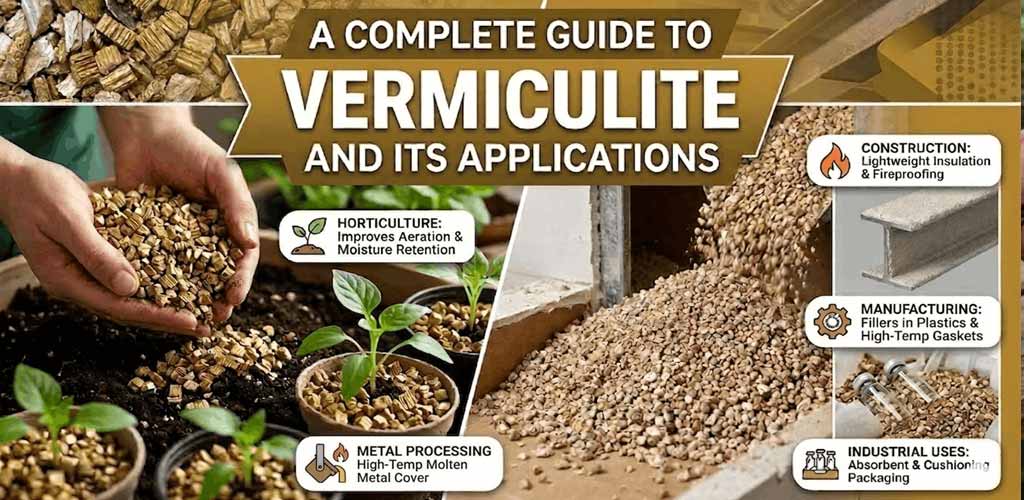
Today, vermiculite plays a crucial role in industries such as agriculture, horticulture, construction, automotive manufacturing, animal feed production, gypsum boards, and paints & coatings. Its ability to retain moisture, resist heat, and remain chemically stable makes it a highly versatile material for industrial and commercial applications.

From improving soil quality in farming to enhancing fire resistance in construction materials, vermiculite continues to be a preferred mineral for manufacturers and industrial buyers worldwide.


What is Vermiculite

Vermiculite is a naturally occurring hydrated magnesium-aluminium-iron silicate mineral which resembles mica in its appearance.

Vermiculite is extracted through open-cast mining, where the ore is separated from surrounding minerals and then screened and classified into different particle size grades.

When heated at high temperatures, the mineral expands into lightweight, accordion-like particles through a process called exfoliation.

This expansion process gives vermiculite several distinctive characteristics:

  • Lightweight structure that reduces material weight in industrial applications
  • Excellent water retention capability, making it ideal for agriculture and horticulture
  • Thermal insulation properties, useful in construction and automotive applications
  • Fire resistance, which improves safety in building materials
  • Non-toxic and chemically inert, making it safe for use in soil, animal feed, and industrial products

Because of these qualities, vermiculite stands out among industrial minerals as a multifunctional material suitable for a wide range of applications.

Types of Vermiculite

Vermiculite is typically available in different forms depending on the stage of processing and intended industrial use.

Raw Vermiculite

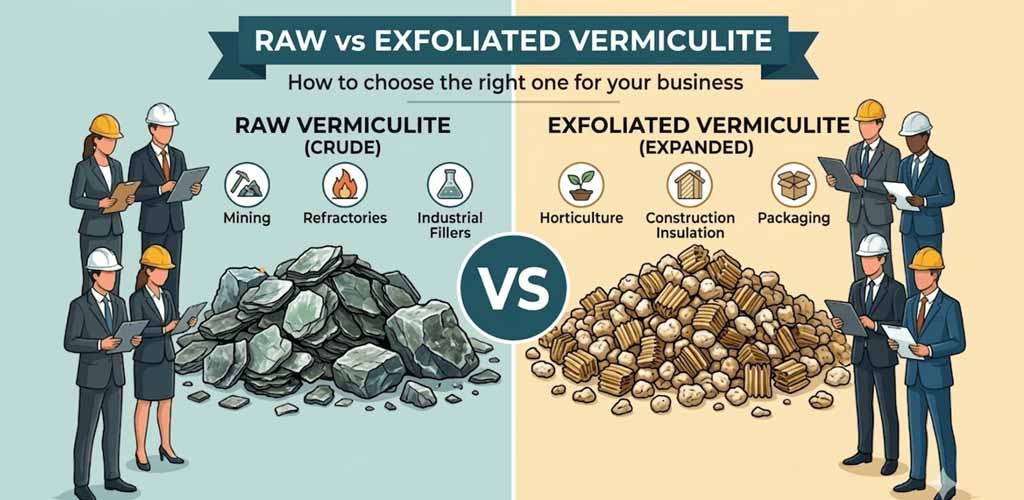
Raw vermiculite is the natural mineral obtained directly from mining deposits. It appears as flaky, layered particles and contains moisture within its structure. Raw vermiculite is primarily used as the base material for further processing.
Industrial manufacturers usually process raw vermiculite through heating to produce expanded or exfoliated vermiculite.

Exfoliated Vermiculite

Exfoliated vermiculite is produced by heating raw vermiculite at temperatures between 800°C and 1000°C. During this process, the mineral expands up to 8–30 times its original size.

The resulting product is extremely lightweight, porous, and highly absorbent. Exfoliated vermiculite is widely used in industries such as agriculture, construction materials, insulation products, and industrial fillers.

Different particle grades are available to suit various industrial applications.

Uses of Vermiculite in Different Industries

Due to its versatility, vermiculite is used across several industries where its insulating, absorbent, and lightweight properties provide significant advantages.

Agriculture

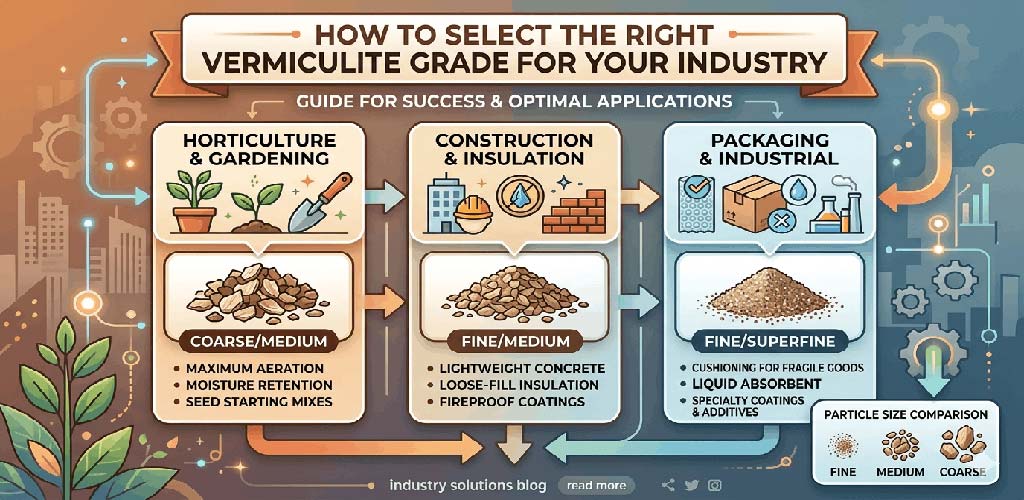
In agriculture, vermiculite is widely used as a soil conditioner. Its excellent water retention properties help maintain soil moisture, which is crucial for plant growth in dry or water-sensitive conditions.

Benefits in agriculture include:

•  Improved moisture retention in soil
•  Better aeration and root development
•  Enhanced nutrient retention
•  Reduced irrigation requirements

Farmers and commercial growers often mix vermiculite with soil to improve crop productivity and soil structure.

Horticulture

In horticulture and plant nurseries, vermiculite is commonly used in seed germination and potting mixes. Its lightweight nature and moisture-retention capacity create the ideal environment for young plants.

Key advantages include:

•   Faster seed germination
•   Consistent moisture availability for seedlings
•   Improved root growth
•   Reduced soil compaction

It is also used in hydroponics and greenhouse cultivation where controlled moisture conditions are important.

Brake Linings

The automotive industry uses vermiculite as a functional filler in brake linings and friction materials. Its heat resistance and structural stability help maintain braking performance under high temperatures.

Benefits in automotive applications include:

•   Improved heat resistance in brake systems
•   Enhanced friction stability
•   Increased durability of brake lining materials

These properties make vermiculite an important component in automotive safety components.

Construction

In the construction sector, vermiculite is valued for its thermal insulation and fire resistance. It is widely used in lightweight concrete, fireproofing materials, and insulation products.

Common construction applications include:

•   Lightweight insulating concrete
•   Fireproof plaster and coatings
•   Insulation boards and panels
•   Low roof sunken filling
•   Water leakage arrester

Its ability to withstand high temperatures while maintaining structural integrity makes it ideal for modern construction materials.

Animal Feeds

Vermiculite is also used as a carrier and anti-caking agent in animal feed production. Its porous structure allows it to absorb and distribute nutrients, vitamins, and supplements evenly within feed mixtures.

Advantages include:

•   Improved feed consistency
•   Better distribution of additives
•   Enhanced storage stability

This helps livestock producers maintain feed quality and improve nutrient delivery.

https://vimeo.com/1173941569?share=copy&fl=sv&fe=ci

Gypsum Boards

In gypsum board manufacturing, vermiculite improves the fire resistance and insulation properties of the final product.

Benefits include:

•   Enhanced fire protection in building materials
•   Reduced product weight
•   Improved thermal insulation

Because of these properties, vermiculite is commonly used in fire-rated drywall and construction boards.

Paints & Coatings

Vermiculite is used as a functional filler and extender in paints and coatings. Its layered structure improves coating performance while reducing product weight.

Advantages include:

•   Improved coating durability
•   Better heat resistance
•   Enhanced texture and coverage

These qualities make vermiculite a valuable additive in industrial coatings and protective paints.

Foundry & Castings

Vermiculite is used in the foundry and casting industry as a lightweight insulating material and protective covering for molten metal. Its high heat resistance and expansion properties help improve casting quality and metal yield.

Benefits include:

•   Excellent thermal insulation during metal casting
•   Reduced heat loss from molten metal
•   Prevention of oxidation and metal contamination
•   Improved casting surface quality and process efficiency

These properties make vermiculite a reliable material for foundry and metal casting applications.

Frequently Asked Questions (FAQs)

1. What is vermiculite used for?
Vermiculite is widely used across industries due to its lightweight structure, high heat resistance, and excellent absorbency. It is commonly used in construction materials, insulation, horticulture, and various industrial applications.

2. Is vermiculite a safe material to use?
Yes, vermiculite is generally considered safe for most applications. It is non-toxic, fire-resistant, and widely used in construction and horticulture.

3. How does vermiculite compare with other insulation materials?
Vermiculite provides strong thermal insulation, fire resistance, and soundproofing properties. These qualities make it a preferred option compared to many conventional insulation materials, particularly in eco-friendly construction projects.

4. Which industries commonly use vermiculite?
Vermiculite is used across multiple industries including construction, horticulture, brake lining, animal feed, foundry, manufacturing, and chemicals because of its insulating, fireproofing, and absorbent characteristics.

5. Is vermiculite used in building construction?
Yes, vermiculite is widely used in building construction. It is commonly incorporated into insulation systems, lightweight concrete mixes, and fireproofing materials.

6. What are the environmental benefits of vermiculite?
Vermiculite is a naturally occurring mineral that is non-toxic and recyclable. Its durability and sustainability make it an environmentally friendly option for construction and industrial applications.

7. How does vermiculite improve energy efficiency in buildings?
Vermiculite provides excellent thermal insulation, helping reduce heat loss in buildings. This improves energy efficiency by lowering heating and cooling requirements.

8. Can vermiculite be used for industrial fireproofing?
Yes, vermiculite is widely used in industrial fireproofing applications because it can withstand high temperatures and provides reliable thermal protection.

9. Is vermiculite suitable for horticulture?
Yes, vermiculite is commonly used in horticulture because it improves soil aeration and enhances water retention, supporting healthy plant growth.

10. What are the key advantages of vermiculite in industrial applications?
In industrial settings, vermiculite is valued for its heat resistance, lightweight nature, and absorbent properties. These characteristics make it suitable for coatings, insulation systems, and other specialized industrial processes.


Conclusion

Vermiculite is a highly versatile mineral with applications across agriculture, horticulture, automotive manufacturing, construction, animal feed production, gypsum boards, and paints & coatings. Its lightweight nature, moisture retention ability, heat resistance, and non-toxic characteristics make it an ideal material for numerous industrial uses.

As industries continue to demand sustainable and high-performance materials, vermiculite remains a reliable solution that enhances product performance while improving efficiency.

At RR Enterprises, we offer premium grade vermiculite to meet the requirements of multiple industries. Whether you are looking for vermiculite for agriculture, construction, automotive components, or industrial manufacturing, we can supply high-quality material tailored to your needs.

For bulk vermiculite requirements, contact RR Enterprises today.
Call us at +91 6382001809

Email: rrmineralspro@gmail.com to place your order or learn more about our vermiculite products.

Denounce with righteous indignation and dislike men who are beguiled and demoralized by the charms pleasure moment so blinded desire that they cannot foresee the pain and trouble.

Latest Portfolio

Need Any Help? Or Looking For an Agent

Working Hours : Sun-monday, 09am-5pm
© 2022 Vankine. All Rights Reserved.